

Introduction
The USS Lunga Point (CVE-94) is one of the lesser-known but highly important escort aircraft carriers used by the United States Navy during World War II. Built during a time of urgent wartime demand, it reflects how quickly naval engineering evolved to support large-scale military operations across the Pacific Ocean.
Unlike large fleet carriers designed for long-term strategic dominance, this ship was built for speed, practicality, and support roles. It served as a floating airbase that could protect convoys, support invasions, and extend air power far into ocean combat zones. Even though its service life was short, its contribution to the Allied war effort remains historically significant.
Wartime Purpose and Background
The USS Lunga Point was constructed during the final phase of World War II when the United States was heavily engaged in the Pacific Theater. The need for escort carriers was growing rapidly because naval warfare had shifted toward air power dominance.
The ship belonged to the Casablanca-class escort carriers, which were designed for mass production. These ships were not built for luxury or long missions but for functionality and speed of deployment. Their primary role was to support larger fleets by providing air cover and reconnaissance capabilities.
The USS Lunga Point was launched in 1944, a period when Allied forces were pushing toward Japanese-controlled territories. Every ship built during this time had a direct connection to ongoing combat operations, and this vessel was no exception.
Meaning Behind the Name
The name “Lunga Point” originates from a coastal area in Guadalcanal, part of the Solomon Islands. This region was the site of one of the most intense battles in the Pacific during World War II.
Naming the ship after Lunga Point was a symbolic decision. It honored the sacrifices made during the Guadalcanal campaign and reminded sailors of the strategic importance of that battlefield. The name carried emotional and historical weight, linking the vessel directly to one of the turning points of the Pacific War.
| Category | Details |
|---|---|
| Name | USS Lunga Point (CVE-94) |
| Type | Escort Aircraft Carrier |
| Class | Casablanca-class |
| Commissioned | 1944 |
| Decommissioned | 1946 |
| War | World War II |
| Main Role | Convoy escort & air support |
| Theater | Pacific Ocean |
| Aircraft Capacity | ~27 aircraft |
| Crew | ~800–900 personnel |
| Fate | Scrapped after decommissioning |
Construction and Design
The USS Lunga Point was built using a highly efficient wartime construction method. Sections of the ship were prefabricated and then assembled in shipyards, allowing it to be completed in a short period of time.
As part of the Casablanca-class, it followed a standardized design that allowed for quick production. This approach was essential during World War II when naval losses needed to be replaced rapidly.
The ship measured just over 500 feet in length and had a flight deck capable of handling multiple aircraft operations at once. While it was smaller than traditional fleet carriers, its design was highly effective for escort duties and combat support roles.
Physical Characteristics and Structure
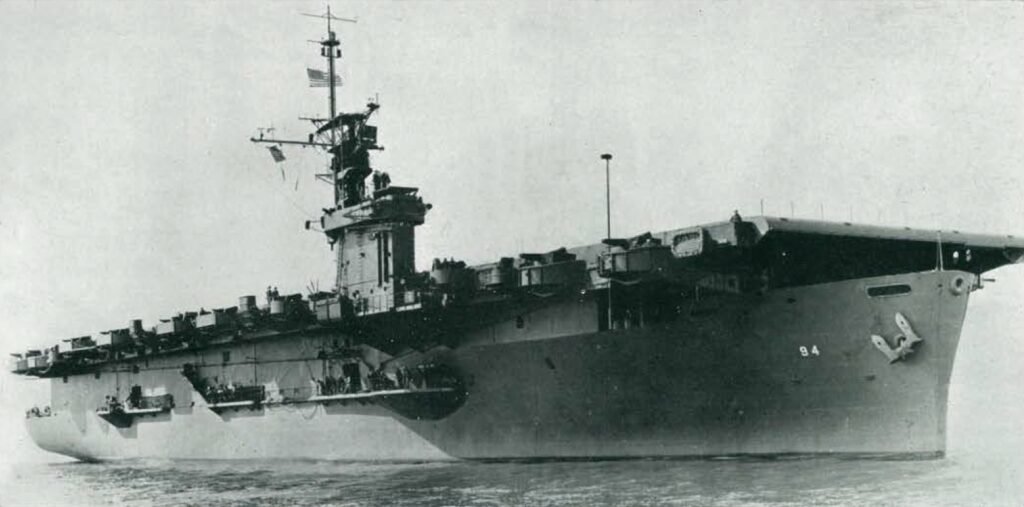
The USS Lunga Point had a practical and compact structure. It was not designed to be visually impressive but rather functionally efficient. The flat flight deck dominated its design, supported by a small superstructure positioned on one side.
It carried around 27 aircraft at a time, including fighters and torpedo bombers. These aircraft formed the ship’s primary combat strength. The vessel could reach speeds of approximately 19 knots, which was sufficient for convoy escort and coordinated naval operations.
In terms of crew, the ship carried nearly 800 to 900 personnel, including sailors, engineers, pilots, and support staff. Every inch of space was used efficiently due to the limited size of escort carriers.
Aircraft Operations and Combat Role
The USS Lunga Point functioned as a mobile airbase at sea. Its aircraft were used for multiple combat roles, including air defense, reconnaissance, and offensive strikes.
Fighter aircraft provided protection against enemy planes, while torpedo bombers were used to attack enemy ships and submarines. These operations were essential for maintaining control over vast ocean areas where land-based air support was unavailable.
Aircraft operations on the ship were continuous during missions. Planes would take off and land in a carefully coordinated system managed by the crew. This constant activity required precision, teamwork, and strict discipline.
Convoy Escort Missions
One of the most important roles of the USS Lunga Point was convoy protection. During World War II, supply convoys were vital for transporting troops, weapons, and resources across the Pacific.
These convoys were frequently targeted by enemy submarines and aircraft. The presence of escort carriers significantly reduced these threats. Aircraft launched from the USS Lunga Point would patrol surrounding waters and detect dangers before they reached the convoy.
This protective role helped maintain the flow of supplies that were essential for sustaining Allied military operations across multiple islands and battle zones.
Support for Amphibious Operations
The USS Lunga Point also played a critical role in supporting amphibious invasions. As Allied forces advanced across the Pacific, they often had to land on heavily defended islands.
In such operations, immediate air support was necessary. The ship provided close-range aircraft operations that helped protect troops during landing phases. This support reduced casualties and increased the success rate of amphibious assaults.
Its ability to bring air power directly into combat zones made it a valuable asset during island-hopping campaigns.
Life Onboard the Ship
Life aboard the USS Lunga Point was disciplined, demanding, and highly structured. The crew worked in tight quarters, with limited personal space and continuous operational duties.
Every member of the ship had a specific responsibility. Pilots, mechanics, engineers, and sailors worked together as a single unit. Aircraft maintenance, navigation, weapon loading, and flight operations continued around the clock.
Despite the harsh conditions, the crew developed strong bonds. The ship functioned like a close community where teamwork and trust were essential for survival and success.
Decommissioning and End of Service
After World War II ended in 1945, many wartime ships were no longer needed. The USS Lunga Point was decommissioned in 1946, only two years after entering service.
It was placed into reserve status and eventually removed from active naval records. Like many escort carriers of its time, it was later scrapped in the following decade.
Although its physical existence ended, its role in wartime operations left a lasting historical record.
Legacy and Historical Importance
The USS Lunga Point remains an important example of wartime naval innovation. Escort carriers like this one demonstrated how air power had permanently changed naval warfare.
These ships proved that smaller, faster-built carriers could still make a major impact in global conflicts. They also showed how industrial production could be mobilized quickly during wartime emergencies.
Their contribution helped shape modern naval strategy, where aircraft carriers remain central to maritime power.
Symbolic Identity and Interpretation
If viewed in human-like terms, the USS Lunga Point can be described as a short-lived but powerful figure. It had a brief active life, yet it operated during one of the most critical periods in naval history.
It had no family or personal identity, but its crew created a strong sense of unity and belonging. Its “appearance” was purely functional—a steel-gray hull, a flat flight deck, and a compact control structure designed for efficiency rather than aesthetics.
It represents a generation of wartime vessels built not for fame or longevity, but for purpose and survival.
Conclusion
The USS Lunga Point (CVE-94) stands as a reminder of how rapidly naval warfare evolved during World War II. It was a product of urgency, innovation, and industrial strength, built to serve a specific mission during one of history’s most intense conflicts.
Although its active service was short, its role in convoy protection, air operations, and amphibious support made it a valuable asset in the Pacific Theater. Today, it remains part of naval history as a symbol of efficiency, adaptability, and wartime engineering achievement.
FAQs
Q: What was USS Lunga Point (CVE-94)?
A: It was a U.S. Navy escort aircraft carrier used during World War II for convoy protection and air support missions.
Q: When was USS Lunga Point commissioned?
A: It was commissioned in 1944 during the final years of World War II.
Q: What was the main role of USS Lunga Point?
A: Its main role was to provide aircraft support, protect convoys, and assist amphibious operations in the Pacific.
Q: How long did USS Lunga Point serve in active duty?
A: It served for a short period, from 1944 until it was decommissioned in 1946.
Q: Why was it named Lunga Point?
A: It was named after Lunga Point in Guadalcanal, a key battle location during World War II.
