

Introduction
The construction industry is one of the most complex and coordination-heavy industries in the world. Every building project involves architects, engineers, contractors, suppliers, and project managers working together under strict timelines and budgets. In such an environment, communication is not just important—it is critical for project success.
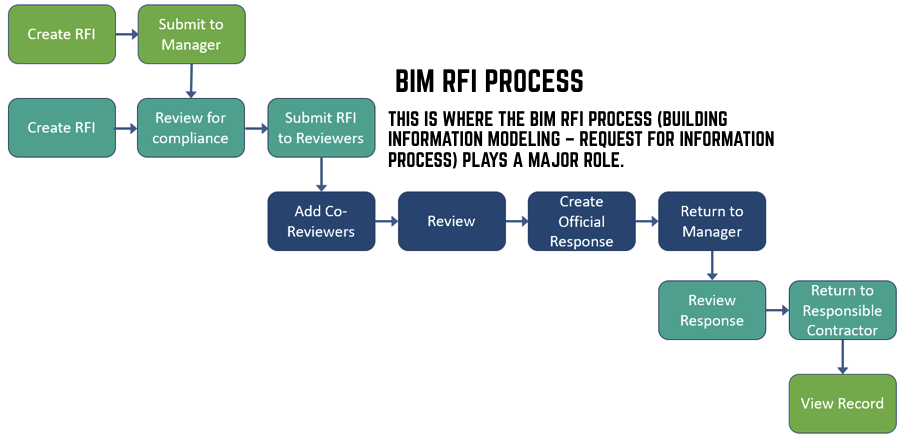
This is where the BIM RFI process (Building Information Modeling – Request for Information process) plays a major role. It has transformed how construction teams communicate, resolve issues, and manage design uncertainties.
Traditionally, construction communication relied on drawings, emails, and paperwork. These methods often caused delays, confusion, and misinterpretation. However, with the rise of BIM-based workflows, the RFI process has become more structured, visual, and efficient.
Today, BIM RFI is not just a digital upgrade—it is a fundamental shift in how construction teams collaborate in real time.
Understanding BIM in Construction
To fully understand the BIM RFI process, we first need to understand BIM (Building Information Modeling) itself.
BIM is not just a 3D model. It is a digital representation of a building that includes geometry, materials, specifications, cost data, scheduling information, and performance details. In simple terms, BIM creates a “living digital building” that evolves throughout the project lifecycle.
Unlike traditional 2D drawings, BIM allows all disciplines—architectural, structural, and MEP (mechanical, electrical, plumbing)—to work in a shared environment. When one component changes, related elements automatically adjust, reducing design conflicts and improving coordination accuracy.
This interconnected system is what makes BIM powerful and also forms the foundation of the BIM RFI process.
Understanding RFI in Construction
An RFI (Request for Information) is a formal communication tool used in construction projects when clarification is needed.
RFIs are usually raised when there is missing information, unclear design details, or conflicts between systems. For example, if a contractor discovers that a ventilation duct conflicts with a structural beam, they will raise an RFI to the design team for clarification.
In traditional workflows, RFIs were managed through emails or documents. While functional, this method often resulted in slow responses, lost information, and confusion due to lack of visual context.
As construction projects became more complex, the need for a better system became obvious.
| Field | Details |
|---|---|
| Name | BIM RFI Process |
| Full Form | Building Information Modeling – Request for Information |
| Type | Construction communication workflow |
| Purpose | To resolve design and site issues using BIM models |
| Used By | Architects, engineers, contractors, project managers |
| Key Benefit | Faster, clearer, and more accurate communication |
| Tools | Revit, Navisworks, BIM 360, Trimble Connect |
| Outcome | Reduced errors, better coordination, less rework |
What is the BIM RFI Process?
The BIM RFI process integrates traditional RFIs directly into BIM environments.
Instead of describing an issue only in text, the user links the RFI to a specific element or location inside a 3D model. This makes the issue instantly visible and easier to understand.
In simple terms, the BIM RFI process turns communication into a visual and data-connected workflow. It removes ambiguity by allowing all stakeholders to see the exact problem within the digital model.
This approach significantly improves clarity, reduces misinterpretation, and speeds up decision-making across construction teams.
Evolution from Traditional RFI to BIM-Based Workflow
Before BIM adoption, RFIs were often time-consuming and inefficient. A contractor might describe an issue in writing, but the design team would need to manually interpret drawings to understand the problem.
This led to multiple rounds of clarification, delayed responses, and increased project costs.
With BIM, this entire process changes. The RFI is no longer just a document—it becomes part of the model itself. Designers can directly view the problem in 3D space, analyze surrounding elements, and respond with accurate solutions.
This shift from text-based communication to model-based communication is one of the most significant improvements in modern construction workflows.
How the BIM RFI Process Works
The BIM RFI process follows a structured and transparent workflow that ensures clarity at every stage of a project.
The process begins when a contractor, engineer, or site team identifies an issue during construction or design review. Instead of writing a long explanation, they create an RFI inside the BIM platform.
This RFI is attached to the exact location in the 3D model. Supporting details such as images, notes, and priority levels are also included to provide full context.
Once created, the RFI is submitted to a Common Data Environment (CDE). This shared digital platform ensures that all stakeholders can access the same updated information.
The design team then reviews the RFI by directly interacting with the BIM model. Since the issue is visually clear, they can quickly analyze conflicts and determine the best solution.
After evaluation, they respond with clarification, design updates, or instructions. If necessary, the BIM model is updated to reflect the corrected information.
Finally, the RFI is closed and stored for future reference, creating a complete audit trail of communication.
Key Stakeholders in the BIM RFI Process
The BIM RFI process involves multiple professionals working together in a coordinated system.
Contractors are usually responsible for identifying issues on-site. Architects handle design clarifications, while structural engineers address load-bearing and structural conflicts. MEP engineers focus on mechanical and electrical coordination issues.
Project managers play a crucial role in tracking RFIs, ensuring timely responses, and maintaining workflow efficiency.
This collaborative structure ensures that no issue is left unresolved and every stakeholder remains aligned throughout the project.
Benefits of the BIM RFI Process
One of the most important advantages of the BIM RFI process is speed. Because issues are visually represented, teams can understand and respond much faster.
Another key benefit is accuracy. Visual context eliminates confusion and ensures that all stakeholders interpret the issue in the same way.
Cost savings are also significant. When RFIs are resolved early, rework is minimized, which reduces labor and material waste.
The BIM RFI process also improves collaboration by bringing all disciplines into a shared digital environment where communication is transparent and centralized.
Finally, documentation becomes more reliable. Every RFI is recorded digitally, creating a complete history that can be reviewed at any stage of the project.
Challenges in Implementation
Despite its advantages, the BIM RFI process does come with challenges.
One major challenge is training. Teams must learn how to use BIM tools effectively, which can take time and effort.
Software costs are another concern, especially for smaller construction firms that may struggle with licensing and infrastructure expenses.
Data management is also a challenge in large-scale projects, where thousands of RFIs and model updates must be tracked accurately.
Additionally, some professionals resist transitioning from traditional workflows to digital systems, slowing down adoption.
Tools Used in BIM RFI Workflow
Several industry tools support the BIM RFI process.
Platforms such as Autodesk BIM 360, Revit, and Navisworks are widely used for modeling and coordination. Cloud-based tools like Trimble Connect and Bentley ProjectWise help teams manage RFIs and collaborate in real time.
These platforms ensure that RFIs are not isolated documents but fully integrated components of the BIM ecosystem.
Best Practices for BIM RFI Management
To ensure success, teams must follow structured practices.
BIM models should always be kept updated to reflect real project conditions. RFIs should be written clearly, with precise descriptions and supporting visuals.
Each RFI should have a responsible owner to ensure accountability. Critical issues should be prioritized to avoid delays in construction.
Standard workflows should be followed across all teams to maintain consistency and efficiency.
Future of the BIM RFI Process
The future of BIM RFI is closely tied to advanced digital technologies.
Artificial intelligence will play a major role in predicting design conflicts before they occur, reducing the number of RFIs needed.
Cloud collaboration will continue to improve, allowing global teams to work on the same project in real time.
Mobile BIM tools will enable site engineers to raise and resolve RFIs directly from construction sites.
In the future, digital twin technology will create real-time virtual replicas of buildings, making issue detection even faster and more intelligent.
Conclusion
The BIM RFI process is a major advancement in construction communication. It combines structured workflows with intelligent 3D modeling to improve clarity, speed, and collaboration.
While challenges exist in adoption and training, the long-term benefits are undeniable. It reduces errors, saves costs, and improves project coordination across all stakeholders.
As the construction industry continues to evolve, the BIM RFI process will remain a core element of modern project delivery—supporting smarter, faster, and more efficient building practices worldwide.
FAQs
Q: What is the BIM RFI process?
A: The BIM RFI process is a digital method of raising and resolving construction questions using a BIM model for better clarity and coordination.
Q: Why is BIM RFI important in construction?
A: It improves communication, reduces errors, and helps teams solve design issues faster using visual 3D models.
Q: Who uses the BIM RFI process?
A: Architects, engineers, contractors, and project managers use it to manage and resolve project-related queries.
Q: How does BIM help in RFIs?
A: BIM connects RFIs directly to 3D models, making issues easier to understand and respond to accurately.
Q: What are the benefits of BIM RFI process?
A: It saves time, reduces rework, improves accuracy, and enhances collaboration across construction teams.
